
FISC: Delivering the Industrial Strategy
Tuesday, 20 January 2026

Over the last four and a half years, FISC has driven innovation across the UK Foundation Industries, enabling over £30 million in capital investment and collaborating with more than 40 companies. From decarbonisation and digitalisation to sustainable materials and skills development, our work is helping to future-proof these vital sectors. Now, with a renewed focus aligned to the UK’s Industrial Strategy, FISC is building market-driven pathways to a low-carbon, resilient, and regionally inclusive economy. FISC Co-Directors Lucy and Sarah reflect on this journey and share what’s next.
Over the past four and a half years, FISC has been scaling innovation across the UK Foundation Industries, aiming to deliver effective decarbonisation solutions to challenges in:
• Alternative fuels
• The circular economy
• Digitalisation
• Process optimisation
• Sustainable materials
• Training and skills
Our efforts have enabled £30 million in installed capital expenditure, over £50,000 in actual and in-kind investment, and collaboration with more than 40 new companies—and that’s just the beginning.
We stepped into our roles as Co-Directors of FISC just one month after the launch of the UK’s Industrial Strategy. This timing gave us a unique opportunity to consider how FISC could leverage its capabilities to:
• Drive innovation
• Increase investment
• Boost productivity and competitiveness
• Tackle regional economic disparities
• Provide long-term economic security for the UK
According to the UK’s Invest 2035 Industrial Strategy, the foundation industries play a critical role in enabling the UK economy. They supply essential materials and components to advanced manufacturing, construction and infrastructure, and clean energy sectors.
The strategy highlights that decarbonising the foundation industries is essential to achieving the UK’s net-zero targets. As some of the most energy-intensive sectors, they require innovation in low-carbon production, recycling and reuse, and resource efficiency to reduce emissions, establish circular supply chains, and support the clean energy transition.
With a strong regional presence in the North East, North West, Midlands, and Wales, investment in these industries will revitalise industrial clusters, create high-quality jobs, and stimulate local economies. Recent global disruptions have underscored the importance of a resilient domestic supply chain—and the foundation industries are key to reducing reliance on imports and strengthening national economic security.
While the foundation industries may not be headline sectors in the strategy, innovation and commercialisation within these industries are vital. They will not only enable net-zero but also drive broader economic growth, create exciting jobs, and ensure long-term security for the UK.
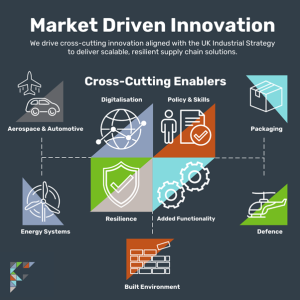
We’ve spent considerable time reflecting on how FISC’s initial aims align with the new strategy. As a result, we’ve revamped FISC’s focus areas to better align with both the Industrial Strategy and our wide-ranging capabilities.
We’ll be working with our networks to design and build market-driven pathways to decarbonisation for the UK Foundation Industries through the implementation of disruptive innovation.
This renewed support for these critical industries is a promising step forward, ensuring that the materials our lives are built on continue to be manufactured in the UK.
Visit FISC at The Advanced Materials Show on stand 626.